
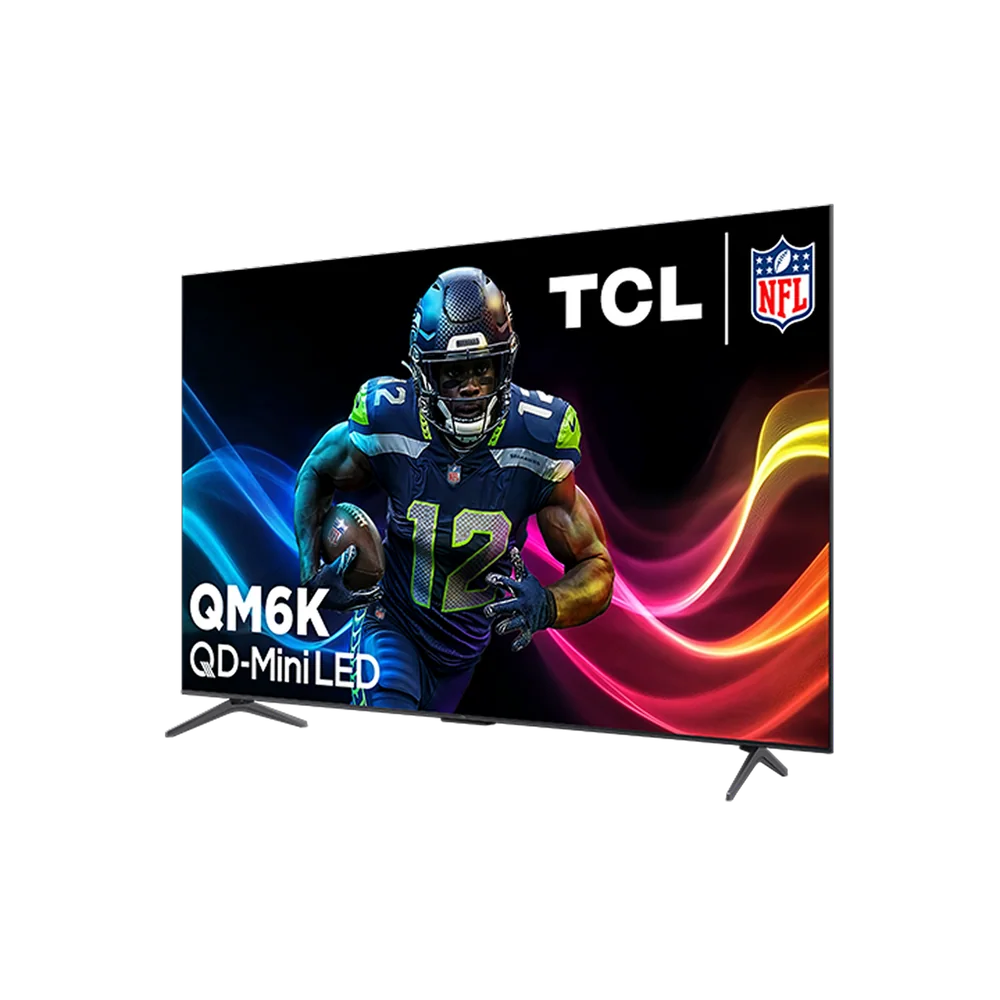
What to know first
- QD-Mini LED backlight with TCL's Halo Control System and up to LD500 dimming zones on the 65-inch model, per TCL's own listing
- 144Hz native refresh rate with Game Accelerator support (240Hz on the 65-inch, 288Hz on the 98-inch, per TCL)
- Runs Google TV as its smart platform, giving it Google's app ecosystem and Chromecast built in
- Supports Dolby Vision IQ, Dolby Atmos, DTS Virtual:X, and IMAX Enhanced certification
- ONKYO-tuned 2.1 speaker system built in, with a metal bezel-less FullView 360 design
- Sizes run from 55 to 85 inches according to TCL's series listing, with 65-inch and 98-inch models specifically documented
TCL's mid-tier Mini-LED, not its flagship
TCL sells four QD-Mini LED tiers this generation: QM6K, QM7K, QM8K, and QM9K, climbing in dimming precision and brightness as the model number rises. The QM6K sits at the bottom of that Mini-LED stack, which matters because it's easy to see 'Mini-LED' on a box and assume you're getting the same panel as TCL's step-up sets. You're not. The QM6K trades some of the dimming-zone density and peak brightness those higher tiers offer for a lower price, while still keeping the core QD-Mini LED architecture instead of a plain LED backlight.
The 98-inch version carries the same pricing structure, which tells you TCL wants this series to compete on square footage as much as picture quality.
No lifecycle information was available to confirm whether this is TCL's newest QM6K generation or how long it's been on shelves, so buyers should check TCL's current 2025 lineup before assuming this is the latest version.
The dimming zones and the format list do the heavy lifting
The headline spec is TCL's Halo Control System paired with up to 500 local dimming zones (LD500) on the 65-inch model, according to TCL's own product listing. In plain terms, that's the panel's ability to dim small sections of the backlight independently, which is what keeps a bright scene from washing out a dark corner of the same frame. More zones generally means tighter control over blooming, the halo effect around bright objects on a dark background, though TCL's number is a manufacturer specification, not an independently measured result.
TCL also built in a wide net of playback formats: Dolby Vision IQ (which adjusts HDR output based on room lighting), Dolby Atmos and DTS Virtual:X for spatial audio processing, and IMAX Enhanced certification for a specific mastering standard used on some 4K Blu-rays and streaming titles. Having all three checked off means fewer format mismatches between what a streaming service sends and what the TV can display at full quality, one of the more common frustrations buyers hit with cheaper sets that support only a single HDR format.
On the gaming side, TCL pairs a 144Hz native refresh rate with ALLM (auto low latency mode) and AMD FreeSync Premium Pro, plus a Game Accelerator mode rated at 288Hz on the documented 65-inch and 98-inch models. A 120Hz-and-up panel is the difference between a fast camera pan looking smooth and looking smeared, and FreeSync Premium Pro specifically targets variable refresh rate gaming on compatible consoles and PCs rather than just movie playback.
Google TV runs the show, and the built-in sound is more than an afterthought
Day to day, the QM6K's smart platform is Google TV, which means the home screen leans on Google's recommendation engine, built-in Chromecast, and Google Assistant voice search rather than a proprietary interface. If your household already lives inside Google's ecosystem (Android phones, Nest devices, Google Home routines), that consistency saves setup time. If you're coming from a Roku or Fire TV household, expect a short adjustment period navigating a different app layout and remote habits.
TCL built an ONKYO-branded 2.1-channel speaker system into the QM6K rather than treating audio as an afterthought bolted onto a thin panel. A 2.1 configuration (two speakers plus a subwoofer channel) won't replace a dedicated soundbar for movie night, but it's a meaningfully better starting point than the tinny two-channel speakers many TVs in this price range ship with, especially for regular TV and streaming audio where you're not chasing full Atmos immersion.
The physical design uses TCL's FullView 360 metal bezel-less build, which keeps the frame thin on all sides rather than just the top and edges. That's a cosmetic detail more than a functional one, but it matters if the TV is going on an open stand where you'll see it from the side or from an angle in a media console.
The number of unknowns is the real caveat here
Every performance figure in this review, dimming zones, refresh rate, motion rate, comes from TCL's own product listings. No independent brightness, contrast, or color accuracy measurements were available to confirm those numbers hold up against a competing Mini-LED set from Hisense or Samsung at a similar price. If picture accuracy out of the box is a priority, budget time to check independent measurements once they're published, and don't assume showroom settings reflect how the panel looks after you dial in your own picture mode.
The QM6K's release timing is also unclear from available information. The only date tied to this model is a March 2025 announcement, not a confirmed release date, and no lifecycle status or successor model information was provided. That's worth a pause if you're trying to time a purchase around a newer model's arrival, since TCL's naming convention (QM6K, QM7K, QM8K, QM9K) suggests this series will eventually be replaced by a next-generation lineup, just not on a confirmed schedule.
Buyers chasing 8K resolution or expecting flagship-level peak brightness should look at TCL's QM8K or QM9K tiers instead. The QM6K is built to undercut those models on price, and TCL's own tier structure implies real gaps in dimming zone count and brightness headroom between this series and the ones above it, even though exact comparative numbers weren't available here.
The specs that matter
Combines a Mini-LED backlight (smaller, more numerous LEDs) with a quantum dot layer for color, aiming for deeper contrast than standard LED-LCD panels without the burn-in risk of OLED.
More independently controlled zones generally means less halo effect (blooming) around bright objects on dark backgrounds, though this is a manufacturer figure, not an independent measurement.
A refresh rate above 120Hz smooths fast motion in sports and action scenes and gives PC or console gamers headroom for high frame rate output, provided the source content supports it.
Handles real-time picture processing tasks like upscaling lower-resolution content to 4K and adjusting motion smoothing, which affects how older shows and cable broadcasts look on the panel.
Covers most major streaming HDR formats, so you're less likely to hit content that falls back to standard dynamic range because the TV lacks the right decoder.
ALLM automatically switches the TV into low-latency mode when a console is detected, and FreeSync Premium Pro reduces screen tearing during variable frame rate gameplay.
Gives noticeably fuller sound than typical flat-panel speakers for everyday viewing, though a separate soundbar is still the better call for serious home theater use.
Determines your daily app experience and voice control options; households already using Google Assistant or Chromecast will find the setup familiar immediately.
Who this product fits
Upgrading from an aging 1080p LED TV
The jump to a QD-Mini LED panel with 4K resolution and proper local dimming will be the most noticeable upgrade in the room, especially for dark movie scenes that used to look gray and flat on an older edge-lit LED set.
Building a console gaming setup without a separate gaming monitor
The 144Hz native panel, ALLM, and FreeSync Premium Pro cover what a current-generation console needs for smooth, low-latency play, making a second gaming display unnecessary for most living room setups.
Furnishing a large den or open-concept living room
With sizes reported up to 98 inches, the QM6K scales into rooms where a 55 or 65-inch set would look undersized, without forcing you into TCL's pricier QM8K or QM9K tiers just to get a bigger screen.
Replacing a TV and a cheap soundbar at once
The built-in ONKYO 2.1 speaker system with Dolby Atmos and DTS Virtual:X processing gives noticeably better sound than a bargain TV's stock speakers, useful for buyers who don't want to shop for audio gear separately right away.
What else to compare
If dimming zone count and peak brightness matter more than price, TCL's own QM7K and QM8K tiers sit directly above the QM6K in its 2025 lineup.
TCL QM6K QLED 4K Smart TV FAQ
Is the TCL QM6K the same as the QM7K or QM8K?
No. All three use QD-Mini LED technology, but TCL's QM6K sits at the entry tier, with the QM7K and QM8K offering higher-end dimming and brightness specifications above it. Don't assume they perform identically just because they share the Mini-LED label.
Does the TCL QM6K support Dolby Vision and Dolby Atmos?
Yes, TCL lists Dolby Vision IQ for adaptive HDR and Dolby Atmos for spatial audio processing, alongside DTS Virtual:X and IMAX Enhanced certification.
What smart TV platform does the QM6K use?
It runs Google TV, which brings Google's app store, Chromecast built in, and Google Assistant voice search to the home screen.
Is the QM6K good for gaming?
It supports ALLM and AMD FreeSync Premium Pro with a 144Hz native refresh rate, and TCL's Game Accelerator mode is rated up to 240Hz or 288Hz depending on screen size, which covers the core needs of current-generation console and PC gaming.
What sizes does the TCL QM6K come in?
TCL's QM6K series listing spans 55 to 85 inches, though documented product pages specifically cover 65-inch and 98-inch models, so check availability for your exact preferred size.
Is the QM6K TCL's newest TV?
That's unclear from available information. Only an announcement date in March 2025 was documented, with no confirmed release date or successor model, so check TCL's current lineup before assuming this is the latest version.
Worth it if you trust the spec sheet
TCL's QM6K makes a real case on paper: Mini-LED contrast control, a 144Hz panel, and a stacked HDR and gaming format list, all priced below TCL's higher QM7K and QM8K tiers. For anyone shopping by feature checklist, it's hard to find a competing set that matches this many boxes checked at a similar price point.
What's missing is independent confirmation that the picture actually delivers on those specs, and clarity on exactly where this model sits in TCL's release calendar. If you're comfortable buying on manufacturer specifications and TCL's track record with QD-Mini LED, the QM6K is a reasonable way into that technology. If you want verified brightness numbers and clear generational timing before spending, wait for that information to surface or lean toward a model where it already has.