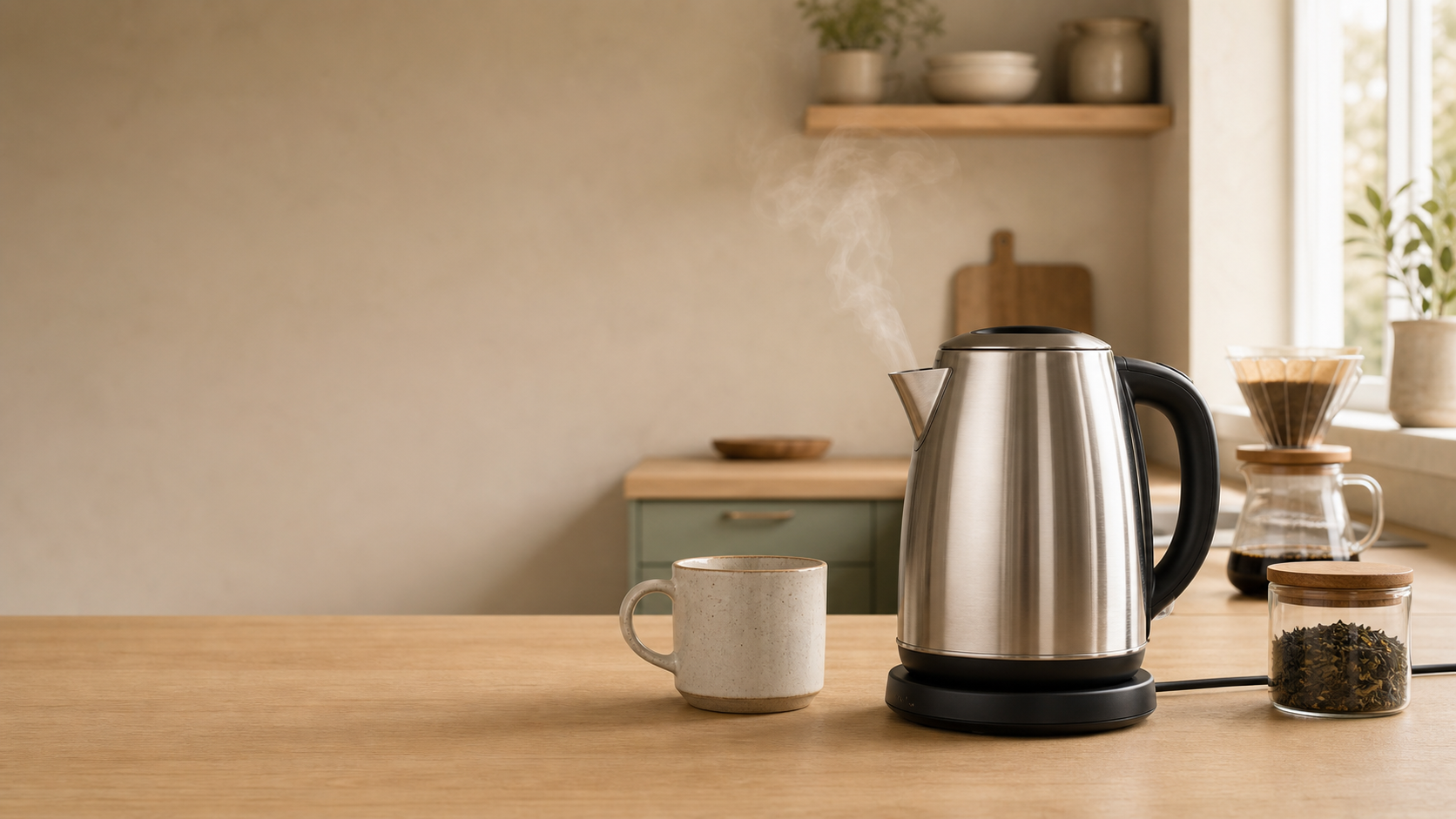
Buy for the routine you actually repeat each morning, not the longest feature list.
Boil-only, presets or exact temperatures?
If you mostly make black tea, herbal tea or instant coffee, a boil-only kettle is the right purchase: nothing to set and nothing to learn. Fixed presets suit people who brew a few different drinks and want each one repeatable. On the All-Clad, you choose one of nine settings with plus and minus, then press Start.
Fine adjustment is worth paying for when a recipe calls for a specific number you'll use again and again. Keep in mind that 1-degree steps tell you which targets you can choose, not how closely the water reaches or holds them. Accuracy is something only measurements can show. A gooseneck spout says nothing about temperature control: the COSORI Original has five fixed presets, while you set the COSORI Smart's custom targets in its VeSync app.
Adjustable temperatures vs. boil-onlyCapacity, minimum fill and the kettle you'll lift
Think in batches, not advertised cups. Assuming 300 mL mugs, a 1.5-liter kettle pours about five before you rinse a teapot or wet a filter. The minimum line matters too. The Aarke's is 0.5 liters, more than one such mug, so a solo tea drinker will always heat a little extra.
A small capacity doesn't guarantee a small kettle on the counter. Check the full footprint of the base and handle, and make sure the lid has room to open under your cabinets without pulling the kettle forward every time. After that, the weight of a full kettle, readable fill marks and a lid wide enough to reach inside for cleaning are what you'll notice every day.
What size kettle do you need?What a steel or glass body doesn't tell you
A steel or glass body isn't proof that water and steam touch only steel or glass. Check the lid underside, filter, seals and sensor, because those are the places where plastic and silicone can sit. The Aarke, for example, combines steel with silicone and plastic.
Glass lets you see the water level, but it can break. Steel hides the level unless there's a window or clear markings inside. We'd choose glass for visibility or steel for a body less vulnerable to knocks; either way, easy-to-read fill markings are worth having. Exterior heat is a separate question from material. A double-wall body can run cooler to the touch, but that doesn't make the lid or spout safe to grab, so hold the handle and keep your hand away from escaping steam.
Steel, glass or plastic?Gooseneck or standard spout?
A gooseneck gives a slow, aimed stream that lets you wet pour-over grounds evenly instead of flooding the bed. That control is the reason to buy one. It isn't a promise of faster heating, and not every gooseneck is small.
For filling mugs, a French press or a teapot, a standard spout is usually the easier tool. Plenty of them still pour with care, the Fellow Clyde among them, so choosing a standard spout doesn't mean settling for a sloppy one. Spout shape is only part of serving, though. A handle that stays balanced as the kettle tips, a pour that stops cleanly without dribbling down the side and a lid that closes securely while the water heats all decide whether every cup lands where you meant it to.
Gooseneck vs. standard spoutKeep-warm versus a kettle that stays hot
An active hold reheats water toward its target, while insulation only slows cooling. On the All-Clad, the 212°F setting holds at 205°F for 30 minutes. If you lift the kettle, return it to the base and press Start to resume the hold. The Aarke has no hold but shows the temperature as the water cools.
A long hold is useful when cups are spread across a slow breakfast or a tea session. If you pour everything at once, being able to restart heating easily matters more than a big hold number.
Adjustable temperatures vs. boil-onlyWhy wattage isn't a boil time
Wattage tells you how much power a kettle can draw, not how quickly it boils your water. To compare two kettles fairly, you need the same volume, the same starting temperature and the US 120-volt version of each.
The simplest way to wait less is to heat only the water you need, staying within the kettle's marked minimum and maximum lines. Trust a speed claim only when it was measured under matching conditions, and don't let a bigger number on the box make the decision for you.
Boiling temperature, time and wattageWhat owner experience actually tells you
When several owners independently report the same specific problem, that tells you more than a high star average. Copied or syndicated reviews are one experience, not several. Incentivized praise doesn't mean a review is fake, but generic delight says little about durability. And a small sample with no complaints doesn't prove a kettle is reliable.
A written warranty tells you what's covered, not how smoothly a claim will go. Read the terms when the kettle arrives. Some, like Aarke's, extend coverage only after you register the kettle.
Noise, odors and scaleWhy the model number matters more than the brand
A familiar brand name tells you less than the exact model does. Cuisinart's PerfecTemp CPK-17P1 has drink presets, while its Soho CK-10BK simply boils. Fellow makes the Stagg EKG Pro, an adjustable gooseneck, and also the Clyde Electric, a standard-spout jug that only boils. COSORI's Original and Smart goosenecks look alike, but only the Smart has app control.
OXO is easy to mix up too: its cordless glass kettle, adjustable-temperature glass kettle and adjustable gooseneck are separate products with different controls and spouts. Aarke and BALMUDA both make premium, design-led kettles, yet they suit different routines once you compare their hold and temperature controls.
Shop by model number, not logo. What a review says about one kettle doesn't carry over to its sibling, even when they share a name.
Adjustable temperatures vs. boil-onlyCompact isn't the same as travel-ready
A small countertop kettle isn't automatically a travel kettle. Check the voltage listed for the exact model, confirm that your hotel or dorm allows kettles, and make sure the kettle, base and cord fit your bag and can be packed completely dry.
A plug adapter changes the shape of the plug, not the voltage, so never run a 120-volt US kettle on 220 to 240 volts. If you travel abroad often, buy a kettle made for your destination's voltage and for the way you'll use it there.
Travel-kettle packing checklistWhere to put your kettle, and when to stop using it
Give the base a stable, level, dry spot away from the sink and the counter edge, near an outlet the supplied cord reaches without stretching. Don't let the cord dangle over the edge or cross a walkway, where a snag could pull a full kettle down. Before cleaning, unplug the kettle, let it cool and never put the electrical base in water.
Stop using a kettle with cracked or chipped glass, a damaged cord, a confirmed leak from the vessel or base, or a shutoff that doesn't work. Once it's safe, unplug it and contact the manufacturer about repair or replacement rather than running another boil to see what happens. Descaling won't fix an electrical fault.
Electric kettle safety: shutoff and boil-dry protection