
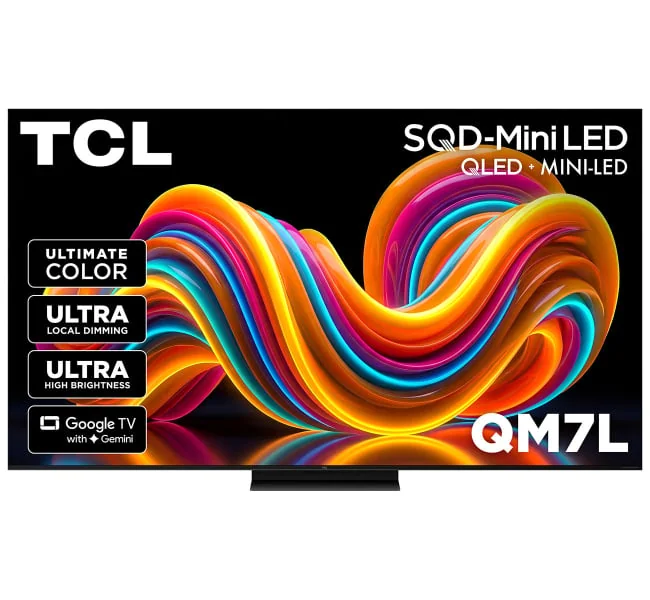
What to know first
- 144Hz native refresh rate and Motion Rate 480 with MEMC target smooth fast motion for sports and gaming
- Both Dolby Vision IQ and HDR10+ are supported, so you're not locked out of either major HDR ecosystem
- TCL's Halo Control System with up to LD2500 dimming zones and HDR 3000 nits peak brightness are manufacturer specs aimed at strong contrast and daylight visibility
- Audio is tuned by Bang & Olufsen with Dolby Atmos decoding, a meaningful upgrade over typical flat-panel speakers
- Google TV runs the show with hands-free voice control, Chromecast, and AirPlay 2 built in
- Only 4 HDMI inputs and Wi-Fi 5, worth planning around if you have a crowded entertainment center
Where the QM7K fits in TCL's mini-LED lineup
TCL sells five separate mini-LED tiers right now, and the QM7K lands in the middle of that stack, above the QM6K but below the QM8K and QM9K. That positioning matters because it tells you what to expect: real mini-LED backlighting and QLED color, but not TCL's absolute best dimming precision or brightness ceiling.
The 55-inch size reviewed here is the smallest in the QM7K series, which scales up to 115 inches. Buying the smallest size in a series usually means getting the least impressive version of the panel's strengths, since smaller screens typically use fewer dimming zones than their larger siblings even when they share a model name.
What TCL is selling here isn't just a screen. It's a full Google TV smart platform, Bang & Olufsen-tuned sound, and gaming features (FreeSync Premium Pro, 144Hz, ALLM) bundled into a set priced to undercut the company's own flagship models.
144Hz and dual HDR support in one panel
Most TVs in this bracket pick a side in the HDR format war. The QM7K supports Dolby Vision IQ, HDR10+, HDR10, and HLG, which means whether you're streaming a Dolby Vision title on one service or an HDR10+ show on another, the picture gets the intended brightness and color mapping instead of falling back to a generic profile.
The 144Hz native refresh rate, paired with TCL's AIPQ PRO processor and Motion Rate 480 with MEMC frame insertion, is aimed squarely at fast motion: sports broadcasts, action movies, and PC or console gaming. Combined with AMD FreeSync Premium Pro and Auto Game Mode, this is a TV built to keep up with a gaming PC or current-gen console, not just tolerate one.
TCL's Halo Control System, with up to LD2500 dimming zones and an HDR 3000 nits peak brightness specification, is the manufacturer's answer to the biggest weakness of older LED TVs: blooming, where bright objects on a dark background cast a visible halo. More dimming zones generally means tighter control over where light appears on screen, though TCL's own spec sheet is the source for these figures rather than independent lab evaluation.
Audio gets real attention too. Bang & Olufsen tuning plus Dolby Atmos decoding is a step beyond the tinny, forward-firing sound most flat panels ship with, and it is a feature that can delay a soundbar purchase for casual viewers.
Living with Google TV and a crowded HDMI bay
Google TV runs the interface, complete with hands-free voice control and a backlit voice remote, plus compatibility with Amazon Alexa, Google Assistant, and Apple HomeKit. That's broader smart-home reach than platforms locked to one ecosystem, useful if your household mixes an Echo speaker with an iPhone.
Built-in Chromecast and Apple AirPlay 2 mean casting from a phone or laptop doesn't require juggling extra dongles or apps, which is a small daily convenience that adds up if you're the type who mirrors a browser tab or a photo slideshow more than you stream from an app.
Four HDMI inputs, with one supporting eARC for a soundbar or receiver, covers a typical setup: game console, streaming box, cable box, and a soundbar. Add a second console or a Blu-ray player and you're reaching for an HDMI switch, since there's no fifth port to fall back on.
Wi-Fi 5 and four ports are the real limits
Wi-Fi 5 instead of Wi-Fi 6 is the clearest sign of where TCL trimmed cost. In a home with several streaming devices competing for bandwidth, Wi-Fi 5 can mean more buffering during peak hours than a Wi-Fi 6 set would show under identical conditions. A wired ethernet connection sidesteps the issue entirely if your router isn't nearby.
Four HDMI inputs is workable but not generous for a TV this feature-rich. Gamers who own both a current console and a gaming PC, plus a soundbar and a streaming box, will run out of ports fast.
Out-of-the-box picture settings on TVs like this tend to favor punchy, oversaturated color for showroom appeal rather than accuracy. Expect to spend a few minutes in the picture menu switching to Filmmaker Mode or a calibrated preset if natural color and correct motion smoothing matter more to you than shelf-shine.
The specs that matter
A native 144Hz panel keeps fast camera pans and gaming motion sharp without the blur a 60Hz set would show, and it's high enough to match a gaming PC's higher frame rate output.
Supporting both major dynamic HDR formats means you get the full picture the content creator intended regardless of which streaming service you're using that night.
More localized dimming zones generally reduce the glow around bright objects on dark backgrounds, and higher peak brightness helps HDR highlights read as genuinely bright in a lit room.
This is the interface you'll touch every day; Google TV's broad app library and voice search make finding something to watch faster than digging through menus.
Four ports fit a standard console-plus-soundbar setup, but a household with multiple gaming devices will want an HDMI switch or fewer connected boxes.
These features cut input lag and prevent screen tearing, which matters more for competitive or fast-paced games than for casual streaming.
Better built-in tuning can delay the need for a soundbar purchase, though a dedicated speaker system will still outperform any TV's internal audio for movie night.
Who this product fits
The living room upgrader replacing an aging LED TV
Coming from a basic LED set, the jump to mini-LED backlighting and dual HDR format support on the QM7K should be immediately noticeable in contrast-heavy scenes and streaming quality, without paying flagship prices for TCL's QM9K.
The console gamer who also streams sports
144Hz, FreeSync Premium Pro, and Auto Game Mode make this a strong pairing for a current-gen console, while the same motion processing helps fast-moving sports broadcasts stay clear during replays and pans.
The renter with a crowded media console
Four HDMI ports and built-in Chromecast plus AirPlay 2 cover a console, streaming stick, and soundbar without extra cables, though anyone adding a second console or a disc player should plan for an HDMI switch.
What else to compare
If four HDMI inputs or Wi-Fi 5 feel limiting, TCL's own QM8K sits a tier above with additional refinements for buyers willing to spend more.
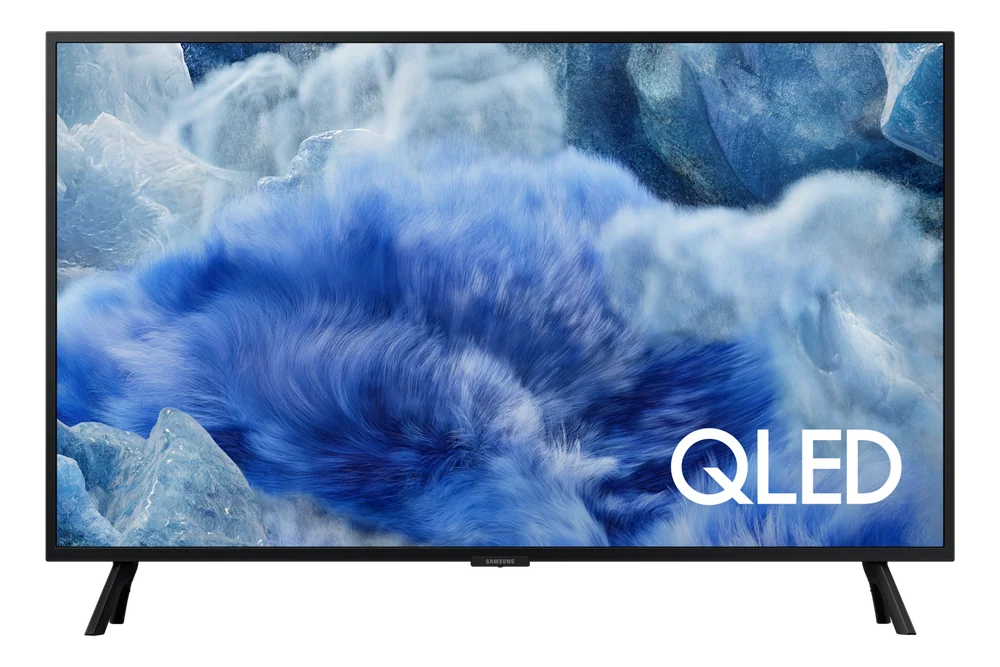
TCL QM7K 55-inch QLED Smart TV FAQ
Does the TCL QM7K support both Dolby Vision and HDR10+?
Yes. It supports Dolby Vision IQ, HDR10+, HDR10, and HLG, so you get the full dynamic HDR experience regardless of which format a given streaming service uses.
Is 144Hz useful if I don't game?
A high refresh rate combined with the Motion Rate 480 processing also smooths sports broadcasts, fast camera pans, and action scenes, so it's not purely a gaming feature even if gamers benefit most directly.
How many HDMI ports does the QM7K have?
It has 4 HDMI inputs, with one supporting eARC for a soundbar or AV receiver. That's enough for a typical setup but tight if you run multiple consoles plus other devices.
Does the QM7K work with Alexa and HomeKit?
Yes, TCL lists compatibility with Amazon Alexa, Google Assistant, and Apple HomeKit on top of the built-in Google TV platform, so it fits into most existing smart home setups.
Is the QM7K the same as TCL's QM8K or QM9K?
No. The QM7K is a step below the QM8K and QM9K in TCL's mini-LED lineup, generally with fewer dimming zones and a lower peak brightness ceiling than those higher-tier series.
Should I adjust the picture settings out of the box?
Most TVs in this class ship with vivid, showroom-tuned picture modes. Switching to Filmmaker Mode or a calibrated preset typically gives more natural color and correct motion handling for home viewing.
Who actually gets their money's worth here
TCL built the QM7K for someone who wants mini-LED brightness, a genuinely fast panel, and broad HDR compatibility without paying for the company's top-shelf QM9K. The gaming feature set, particularly 144Hz and FreeSync Premium Pro, is unusually strong for a set positioned in the middle of TCL's lineup, and the dual Dolby Vision and HDR10+ support means you're not gambling on which format your favorite streaming service picked.
The tradeoffs are specific and manageable: Wi-Fi 5 instead of Wi-Fi 6, and four HDMI ports instead of a more generous allotment. Neither undermines the core experience. If your setup doesn't demand extra ports or bleeding-edge wireless speed, the QM7K delivers a lot of TV, and a lot of TCL's better hardware, for less than its flagship siblings ask.