
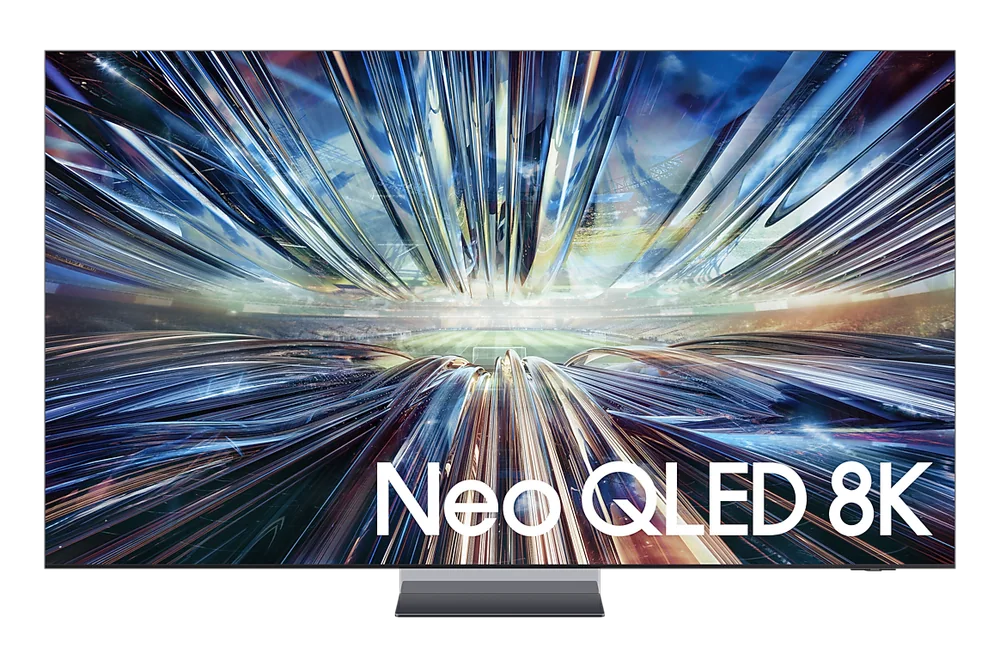
What to know first
- NQ8 AI Gen3 processor drives 8K AI Upscaling Pro, the feature that actually matters for everyday viewing
- Available in 65, 75, and 85-inch sizes; no smaller options exist for tighter rooms
- 85-inch set weighs 42.7 kg without stand, 69.4 kg with packaging, per Samsung specs
- Runs Samsung's Tizen OS smart platform with the usual app ecosystem
- One independent review called picture quality and AI upscaling standout strengths of this model
- 8K content remains nearly nonexistent, so the resolution number is mostly a future-proofing bet
Samsung's flagship answer to a resolution nobody streams yet
The QN900D sits at the top of Samsung's Neo QLED lineup, built around Mini LED backlighting and an 8K panel that outpaces what almost any streaming service, cable box, or game console can actually deliver right now. That's not a flaw unique to this TV, it's true of every 8K set on the market. What separates the QN900D is the processor Samsung put behind that panel.
The NQ8 AI Gen3 chip and its 8K AI Upscaling Pro feature exist specifically to bridge that gap, analyzing incoming video and reconstructing detail so a 4K Blu-ray or a standard cable broadcast looks closer to native 8K than it has any technical right to. That's the actual product here: a very capable image processor wrapped in an 8K display, sold to buyers who want the best possible version of the content they already watch.
It's a Tizen OS smart TV at its core, running Samsung's usual app suite and Smart Things integration, which matters if you're already living in a Samsung phone, watch, or appliance ecosystem where cross-device features tend to click together more smoothly.
The upscaling is the upgrade, not the resolution count
One independent review described the QN900D's picture quality and AI upscaling as standout strengths, and that lines up with how the hardware is designed to work. Rather than treating 8K as a spec-sheet number, Samsung leans on the processor to make lower-resolution sources look meaningfully better, which is the more useful capability for the vast majority of households that don't have 8K source material sitting around.
This is the practical case for paying flagship money here over a step-down 4K Neo QLED: you're not buying resolution you'll use today, you're buying a processor that makes everything you already watch look sharper. If that trade doesn't interest you, a 4K Neo QLED gets you close to the same picture for less, since 8K content availability isn't changing that calculation anytime soon.
Where the extra resolution could eventually pay off is longevity. If 8K broadcasts, streaming tiers, or game consoles become more common over the TV's lifespan, the QN900D is already built for that future. It's a bet on where content is headed, not a benefit you cash in on day one.
Living with a TV this large means planning the install first
Size is the first ownership decision the QN900D forces on you, since it only comes in 65, 75, and 85 inches. There's no compact version for a bedroom or a modest living room, so measure your wall and viewing distance before you fall for the picture quality in a showroom.
Weight is the detail that catches people off guard. Samsung's own specs put the 85-inch set at 42.7 kg without its stand and 69.4 kg once boxed for shipping, with the 65-inch model considerably lighter at 21.6 kg without stand. Anything at the 75 or 85-inch size is a two-person unboxing and mounting job, not a solo Saturday project, and wall-mount brackets need to be rated for that weight before you buy them.
Day-to-day, you're navigating Tizen OS for apps and streaming, which is a familiar, capable smart platform rather than a novelty. If your household already uses Samsung SmartThings for other devices, the TV tends to slot into that setup instead of becoming a separate island to manage.
Where the 8K promise runs into reality
The most honest thing to say about this TV's headline spec is that 8K content is nearly nonexistent right now. You're not going to stream 8K from major services or find much physical 8K media, so the resolution number is a long-term bet rather than something that changes your Tuesday night movie.
Out-of-the-box picture settings on flagship TVs are often tuned for a bright showroom rather than an accurate home viewing experience, and there's no reason to assume the QN900D is different. Budget for some time in the settings menu, or a calibration profile, if color accuracy matters more to you than punchy defaults.
Size and weight cut against flexibility too. Committing to an 85-inch, 69-kilogram-boxed television is a permanent decision about your room, not something you casually reposition later. If you might move within a couple of years, or you're not sure the space can handle a screen that large, that's worth resolving before you order.
The specs that matter
This chip drives the AI upscaling that makes lower-resolution content look sharper, which is the feature you'll actually notice night to night, far more than the 8K panel itself.
Since almost nothing streams natively in 8K, this feature is what turns your existing 4K and HD sources into the picture you're paying for.
There's no smaller version, so this TV is built for larger rooms and longer viewing distances where its detail and brightness can actually be appreciated.
You'll use this daily for apps and navigation; it pairs naturally with Samsung SmartThings if you own other Samsung devices.
This is the number to check against your wall mount's weight rating before installation, not an estimate you can round down.
Plan for a two-person delivery and unboxing job at this size; it's not a TV one person carries up a flight of stairs alone.
The smallest available size is meaningfully easier to handle solo, worth knowing if you're the one doing the install.
Who this product fits
Upgrading from an aging 4K TV for movie nights
You'll notice the upscaling immediately on regular 4K and HD content, since that's what the NQ8 processor is built to enhance. The jump in perceived detail and brightness will likely feel bigger than the 8K label suggests, because it's the processing, not the raw resolution, doing the visible work.
Building a large-room home theater at 75 or 85 inches
This is where the QN900D's size options and picture processing pay off most, since a bigger screen makes upscaled detail and Mini LED brightness control easier to appreciate from a normal couch distance.
Shopping on a tighter budget or for a smaller room
A step-down 4K Neo QLED gets you similar brightness and color performance for less money, and there's no smaller QN900D size to fit a compact room anyway. Save the flagship budget for a size and generation where you'll actually use every feature.
Wall-mounting the 85-inch model yourself
Confirm your mount is rated well above 42.7 kg and arrange a second person for the install. This isn't a TV you want to discover is too heavy for your bracket mid-hang.
What else to compare
A few other paths are worth weighing before committing to the QN900D.
Samsung QN900D Neo QLED 8K TV FAQ
Is the Samsung QN900D worth buying if I don't watch any 8K content?
Yes, because the appeal isn't native 8K playback, it's the AI upscaling that improves whatever you already watch. If you never plan to use 8K sources, you're still getting real benefit from the processor, just less benefit from the panel's maximum resolution.
What screen sizes does the QN900D come in?
Samsung offers the QN900D in 65, 75, and 85-inch sizes. There's no smaller option, so it's built for medium to large rooms rather than bedrooms or tight apartments.
How heavy is the QN900D to install?
The 85-inch set weighs 42.7 kg without its stand and ships at roughly 69.4 kg according to Samsung's specifications; the 65-inch model is lighter at 21.6 kg without stand. Larger sizes call for two people during unboxing and mounting.
Does the QN900D run Samsung's Tizen smart platform?
Yes, it uses Tizen OS for apps, streaming, and navigation, and integrates with Samsung SmartThings if you're already using other Samsung smart devices.
Should I buy the QN900D over a 4K Neo QLED model?
Choose the QN900D if you want the strongest available upscaling processor and plan to run a large screen at 75 or 85 inches. If budget matters more than future-proofing for possible 8K content, a 4K Neo QLED delivers similar everyday picture quality for less.
Who actually needs this over a 4K flagship?
Buyers chasing an 8K number on a spec sheet are chasing the wrong feature here. The QN900D earns its price through the NQ8 AI Gen3 processor and its upscaling, which independently reviewed picture quality suggests is genuinely strong, not through content that essentially doesn't exist yet for most households.
If you want a large-screen flagship that makes your existing 4K library and cable package look noticeably better, and you've got the room and the muscle (or the help) to install an 85-inch, nearly 70-kilogram-boxed television, the QN900D delivers. If you're chasing 8K resolution itself, or you need something smaller and cheaper, a 4K Neo QLED gets you most of the same everyday experience for meaningfully less money.