
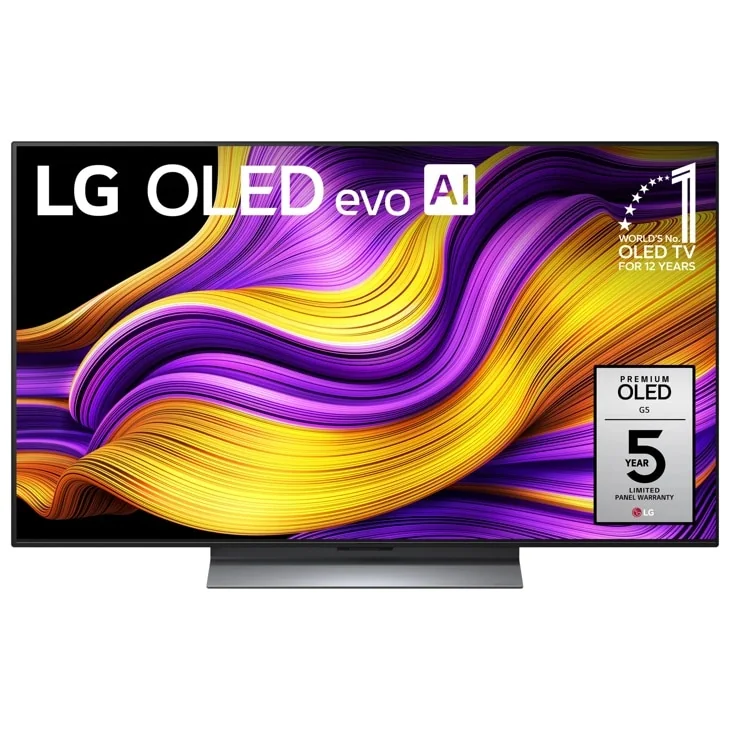
What to know first
- Announced April 9, 2025, as LG's flagship OLED evo tier for that year
- Still sold into 2026, including clearance pricing, with no successor named
- OLED evo is LG's own brightness-enhanced refinement of standard OLED panel technology
- Positioned as LG's high-end, wall-mount-oriented G-series design
- Best value case is now, as a discounted flagship rather than a launch-price purchase
LG's 2025 flagship, now aging into a bargain
The LG OLED evo G5 4K TV sits at the top of LG's G-series, the lineup LG builds specifically for buyers who plan to mount the TV flat against a wall and want the best picture LG can put behind that thin profile. It was announced on April 9, 2025, as that year's flagship expression of LG's OLED evo panel technology, LG's branding for an OLED panel refined to push more brightness than a standard OLED design.
What makes the G5 worth tracking now, rather than at launch, is timing. LG hasn't named a successor to this model, and it's still selling into 2026 with clearance promotions showing up regularly. That's the window where a flagship television usually makes the most financial sense: the technology hasn't been superseded, but the launch premium has eroded.
This isn't a mid-range TV pretending to be a flagship. It's a genuine high-end LG OLED that happens to be available at a point in its life cycle when the price has caught up to what most buyers are actually willing to pay for it.
Buying a flagship after the hype has faded
Most people don't buy a flagship TV the week it's announced. They buy it a year later, once the price has settled and the early bugs, if there were any, have been sorted out through software updates. The LG OLED evo G5 4K TV is squarely in that phase now, which is a better position for a shopper than it sounds.
There's no rival LG model actively competing for the G5's spot in the lineup, since no successor has been announced. That absence of a newer sibling means you're not buying something that LG itself is quietly trying to move you away from. You're buying the current answer, not a soon-to-be-outdated one.
The comparison worth making isn't G5 versus next year's unreleased model. It's G5 at 2025 launch pricing versus G5 at 2026 clearance pricing. For a shopper who cares about picture quality but not about being first, the second option is the more rational one.
Living with a wall-first OLED and LG's webOS
The G-series exists because LG assumes serious buyers mount their TVs, and that design intent shapes daily use more than most spec sheets let on. A set built for wall-mounting tends to prioritize a slim profile and clean cable management over the kind of built-in stand flexibility a budget TV offers, so factor mounting hardware into your setup plan rather than assuming a tabletop stand comes standard.
Day to day, you're interacting with LG's webOS smart platform far more than you're thinking about the panel underneath it. A smart TV's operating system is the layer between you and every app, input, and setting, and a slow or cluttered one undercuts even the best picture quality sitting behind it. Anyone considering the G5 should treat the platform experience as seriously as the panel spec when deciding whether the price is right for them.
Because the G5 has been on the market since April 2025, its software has had time to mature through updates, which is generally a better position to buy into than a brand-new platform still working out early kinks.
What the spec sheet won't tell you upfront
One honest caveat: exact details like HDMI 2.1 port counts and specific HDR format support (Dolby Vision, HDR10+, or both) should be confirmed against LG's current listing before you buy, since those specifics can vary by screen size within the same model line and aren't locked down here. If you're pairing this with a next-gen gaming console or a specific streaming box, verify port specs match your setup before ordering.
Marketing language around any high-end OLED, including phrases like cinema-quality picture, usually describes a factory setting tuned for showroom brightness rather than accuracy. Expect to spend a few minutes in the picture settings menu after setup if you want the panel's actual OLED strengths, deep black levels and rich contrast, to show up the way they're capable of.
The bigger structural catch is that this is a 2025 release with no confirmed successor yet. That's good news for pricing today, but it also means LG could announce a G6 at any point that resets the flagship conversation. Buyers who want to be first in line for whatever comes next should hold off; buyers who want proven flagship performance at a discount don't have much reason to wait.
The specs that matter
OLED evo is LG's own refinement built to push brighter highlights than standard OLED panels, which helps HDR content look punchier in a well-lit room without losing OLED's deep black levels.
The G-series is designed around flat wall mounting rather than tabletop stands, so plan your installation around that assumption rather than a traditional TV stand setup.
This tells you the G5 is a full model year into its life cycle, which is typically when flagship TVs see the steepest price drops relative to launch.
Without a confirmed replacement model, you're not at risk of buying into a lineup that's about to be visibly outdated by a direct successor.
This is the interface you'll use daily for streaming apps, inputs, and settings, so its responsiveness matters as much as picture quality for how the TV feels to live with.
Continued availability at reduced pricing means the best time to buy a G5 may be now, rather than at its original 2025 launch price.
Who this product fits
The wall-mount upgrader
If you're replacing an aging TV and planning a flush wall mount in a living room or media wall, the G-series design intent lines up directly with what you're trying to build. The G5 gives you LG's current flagship panel without waiting on whatever replaces it.
The value-conscious flagship buyer
Someone who wants high-end picture quality but refuses to pay launch pricing is exactly who benefits from the G5's current position in the market. Clearance-era pricing on a still-current flagship is a better deal than buying a brand-new model at full price.
The buyer chasing the newest tech
If your priority is owning whatever LG considers its most advanced OLED at any given moment, waiting for a named successor makes more sense than buying a 2025 model now, even at a discount.
What else to compare
A few situations point toward a different choice entirely.
LG OLED evo G5 4K TV FAQ
Is the LG OLED evo G5 4K TV still worth buying in 2026?
Yes, largely because it remains LG's current flagship OLED with no successor announced, and it's often available at clearance pricing well below its 2025 launch cost. You're getting a proven, mature product rather than a brand-new model still working through early software updates.
What does OLED evo mean on the LG G5?
OLED evo is LG's branding for a panel technology refined to produce brighter highlights than a standard OLED panel, while keeping OLED's characteristic deep black levels. It's meant to improve HDR content in rooms with more ambient light.
Does the LG G5 need to be wall-mounted?
It doesn't have to be, but the G-series is specifically designed with wall mounting in mind, favoring a slim profile over tabletop stand flexibility. Buyers should factor mounting hardware into their setup plans rather than assuming a full-featured stand is the primary use case.
Is there a newer model than the G5 I should wait for?
As of now, LG hasn't announced a named successor to the G5, so there's no confirmed newer flagship to wait for. If you need the newest possible OLED technology under the hood, that's still a reason to hold off, but there's no specific upcoming model to point to.
Should I adjust the picture settings out of the box?
Most flagship OLEDs, including this one, ship with factory settings tuned for showroom brightness rather than accurate color and contrast. Spending a few minutes in the picture menu after setup typically gets closer to what the panel is actually capable of at home.
Buy the flagship now, not the wait
Flagship televisions rarely make the most financial sense in their first few months on shelves. The LG OLED evo G5 4K TV, announced in April 2025 and still selling into 2026 with clearance pricing and no named successor, has moved past that window into the part of its life cycle where the value case is strongest.
If you want LG's current high-end OLED experience and you're comfortable buying a proven 2025 model rather than waiting for an unannounced replacement, this is the right moment to buy it. If your priority is always owning the newest possible panel technology regardless of price, hold off, but recognize that no specific successor has been confirmed to wait for yet.