
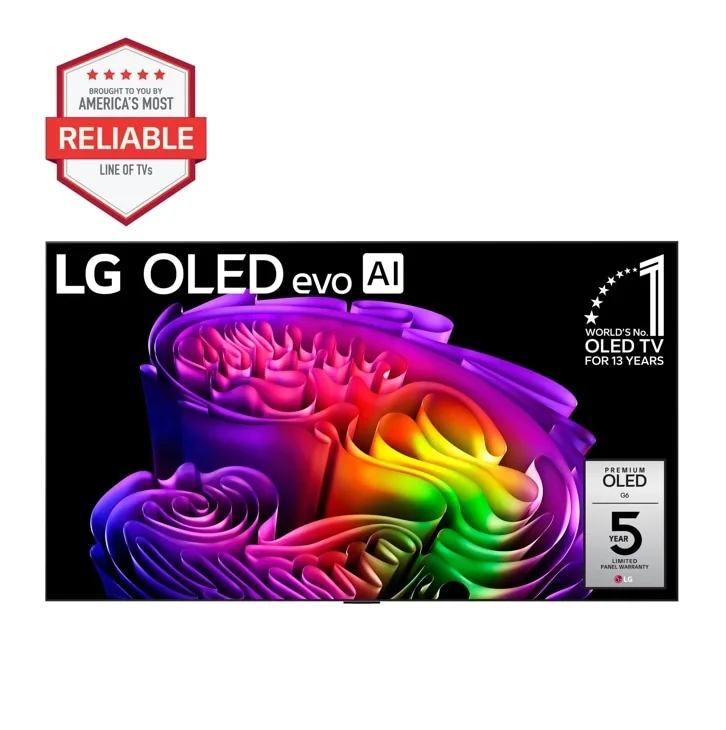
What to know first
- LG rates the G6 as its brightest OLED to date, claiming up to 3.9x the brightness of earlier OLED generations
- Available in 65, 77, and 83 inch classes, with the 83 inch model weighing about 59.4 kg (roughly 131 lbs) panel-only
- Standby power draw is rated under 0.5W, a small but real saving over years of ownership
- One independent review noted a build issue on its specific test unit worth checking for on arrival
- Part of LG's 2026 OLED evo AI lineup, designed as the flagship above the C-series
LG's answer to the brightness complaint
Every generation of LG's G-series OLED has chased the same goal: keep OLED's perfect black levels while closing the brightness gap with LED and mini-LED sets. The G6 OLED is LG's most aggressive attempt yet, built around what the company calls Hyper Radiant Color Tech and an Alpha 11 AI Processor Gen3 to drive it.
Sitting at the top of LG's 2026 OLED evo AI lineup, the G6 is positioned above the mainstream C-series as the flagship for buyers who want the newest panel technology first. It ships in 65, 77, and 83 inch classes, giving households room to match screen size to viewing distance without stepping down to a lesser panel.
LG designed the G6 for wall mounting rather than a furniture-style stand, which fits its role as a gallery-style centerpiece. That's a deliberate choice buyers should plan around before purchase, not an accessory decision made after the TV is already on the wall.
A brightness jump you can actually see
LG specifies the G6 as its brightest OLED ever, rating it up to 3.9x brighter than earlier OLED generations. That's a manufacturer figure, and it should be read as LG's own performance claim rather than an independently confirmed number, but even a fraction of that gain would change how the TV performs in a living room with afternoon sun coming through the window, a scenario where older OLEDs have historically looked flat and gray.
The panel carries over 8.3 million self-lit pixels, paired with what LG calls Perfect Black and Perfect Color technology. In practice, that combination is what lets an OLED show a starfield and a lit lamp in the same frame without either one looking wrong, and it's the reason people pay OLED prices instead of buying a bright mini-LED set and calling it a day.
Compared to shopping for a mid-range LED TV, the calculus here is simple: you're paying for contrast and color accuracy that LED backlighting still can't fully replicate, plus a brightness ceiling that finally makes OLED viable in rooms LG's older panels struggled in.
Living with a wall-mounted flagship
Because the G6 is built around flush wall mounting, the ownership experience starts with installation planning rather than unboxing. A buyer choosing the 83 inch class is working with a panel weighing about 59.4 kg (nearly 131 lbs), and the 77 inch class comes in at 52 kg. Those numbers matter less for lifting than for wall anchoring: this is not a TV you casually reposition once it's up.
Standby power draw rated under 0.5W is a small line item that adds up over years left plugged in on standby, and it is a detail that won't change your day-to-day experience but is worth knowing if efficiency factors into your buying decision.
Day-to-day interaction runs through LG's webOS platform and the Alpha 11 AI Processor Gen3, which handles everything from app loading to upscaling older content. For a household juggling streaming apps, game consoles, and a soundbar, the daily experience comes down to how quickly that platform responds, not just how bright the panel gets.
What one review flagged, and what to check on arrival
One independent evaluation praised the G6's build quality and premium materials overall, but noted a specific issue with its particular review unit. That's a single data point, not a pattern across every G6 sold, and it shouldn't be read as a guaranteed flaw. It is, however, a good reason to inspect your TV carefully when it arrives and before the wall mount goes up permanently.
LG's 3.9x brightness claim is exactly that: a manufacturer specification, not an independently verified consensus figure. Treat it as directional evidence that the G6 is meaningfully brighter than older OLED generations, not as a number you should expect to replicate with a light meter at home.
Buyers on a tighter budget should also weigh whether the flagship brightness gain is worth skipping LG's C-series, which typically costs less and still delivers strong OLED picture quality for rooms without major daylight glare.
The specs that matter
This is the G6's core selling point: it targets the daytime-viewing weakness that has held OLED back in bright rooms, though the exact multiplier is a manufacturer figure, not an independent measurement.
Picking the right size for your seating distance avoids either straining to see detail or losing the immersive effect a large OLED panel is built to deliver.
At this size and weight, wall mounting needs real planning: stud placement, mount rating, and probably a second set of hands.
Even the smallest G6 class is heavier than a comparable LED TV, since OLED panels carry a different internal structure.
A low standby draw keeps the TV's idle electricity cost negligible over years of being plugged in but not actively watched.
This chip drives upscaling, motion handling, and the smart platform's responsiveness, so it affects daily usability well beyond raw picture specs.
Buyers who prefer a tabletop stand setup should confirm compatibility and installation plans before purchase rather than after delivery.
Who this product fits
The sunlit living room upgrade
A household replacing an older OLED that always looked washed out during the day is the clearest fit for the G6. LG's brightness claim directly targets that complaint, and the panel's Perfect Black tech should keep evening movie nights looking as good as the old set did after dark.
The wall-mount-first buyer
Someone already planning a flush wall installation, rather than a stand and console setup, gets a TV designed around exactly that use case. The tradeoff is committing to wall mounting before the design's tabletop limitations become a problem after purchase.
The budget-conscious shopper eyeing last year's set
A buyer who doesn't need cutting-edge brightness and mostly watches in a dim room in the evening may get more value stepping down to LG's C-series, saving money without losing much day-to-day picture quality.
What else to compare
A few adjacent choices are worth weighing before settling on the G6.
LG G6 OLED FAQ
Is the LG G6 OLED worth it over the C-series?
If you watch TV in a bright room during the day, the G6's brightness advantage is the reason to pay more. If most of your viewing happens in a dim room in the evening, the C-series likely delivers comparable satisfaction for less money.
Does the LG G6 OLED need to be wall mounted?
LG built the G6 around flush wall mounting as its primary installation method. Buyers who strongly prefer a tabletop stand should confirm what stand options exist for their chosen size before purchase.
How much does the LG G6 OLED weigh?
Weight varies by screen size: LG specifies about 52 kg for the 65 inch class and about 59.4 kg for the 83 inch class. Larger classes require sturdier wall anchoring and likely two people to install safely.
Is LG's 3.9x brightness claim accurate?
That figure comes from LG's own specifications comparing the G6 to earlier OLED generations, not from an independent brightness measurement. Treat it as a manufacturer target rather than a guaranteed multiplier you'll see with a light meter.
Are there any known issues with the LG G6 OLED?
One independent evaluation noted a build issue on its specific review unit, though it also praised the TV's overall build quality and materials. It's worth inspecting your unit closely upon arrival, but there's no documented pattern of widespread defects.
Who actually needs this much OLED brightness
The G6 makes its case with a straightforward pitch: LG's brightest OLED yet, built to solve the one real weakness OLED has always had against sunlight and glare. For anyone whose current TV disappears into a washed-out mess the moment afternoon light hits the room, that pitch is worth the premium.
For everyone else, the calculus is less obvious. If your viewing happens mostly after dark, in a room where light control is already handled, the extra brightness LG is charging flagship money for won't change your experience much, and LG's own C-series will likely get you 90 percent of the satisfaction for meaningfully less. Buy the G6 for the room that's been fighting you for years. Skip it if your room was never the problem.