
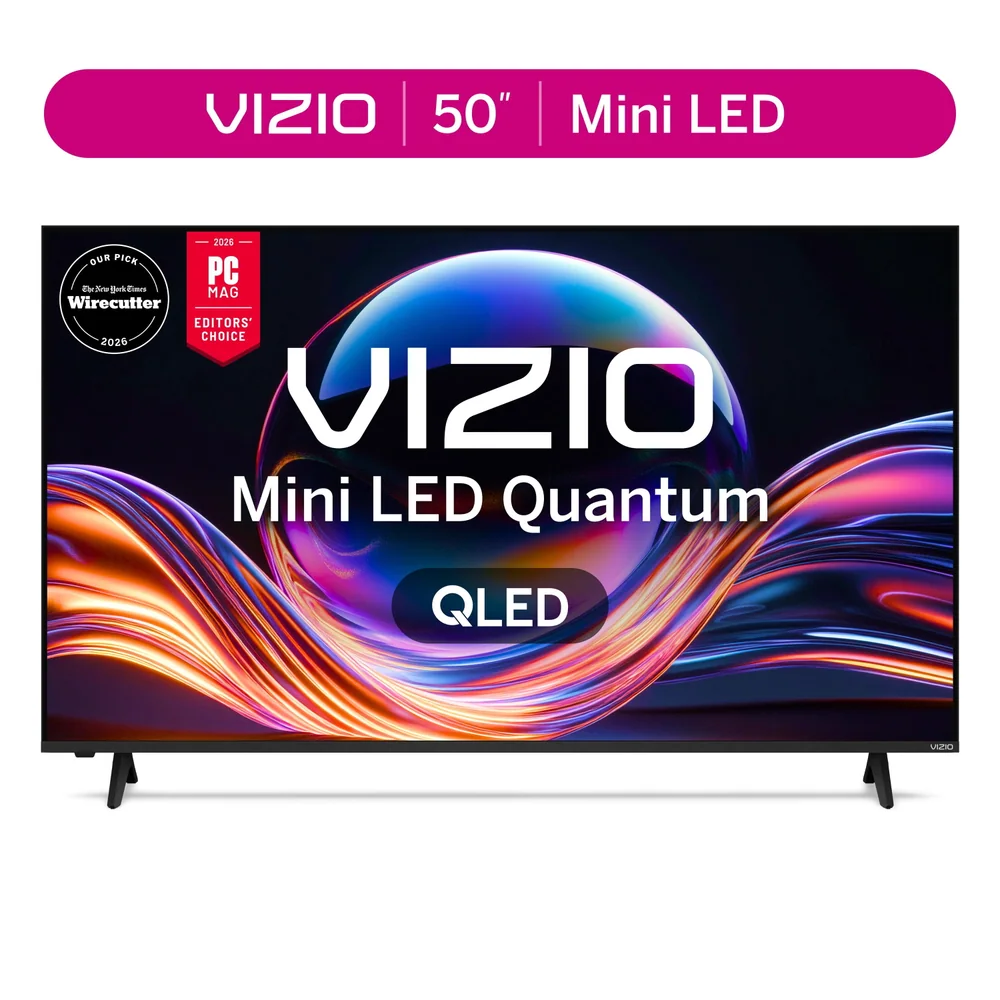
What to know first
- Mini LED backlighting with local dimming zones aims to fix the classic LED weakness: hazy blacks next to bright highlights.
- Quantum dot color filtering pushes past a billion colors, a spec Vizio ties to roughly 75% more color range than a standard 4K panel.
- Dolby Vision HDR is standard across the lineup, though exact HDR format support can vary by specific model number.
- Dual-band WiFi 6 is built in, which matters more than it sounds once several smart home devices are competing for bandwidth.
- Sizes run from 43 to 85 inches, so the panel technology doesn't force a compromise on room size.
- Gaming support tops out at 120fps in 1080p, a spec worth checking against your console's actual output resolution.
Where Mini LED Quantum fits in Vizio's lineup
Vizio splits its current TV shelf into tiers, and Mini LED Quantum sits above the standard Quantum 4K line and below OLED, which is exactly where the pricing and performance land. It's the series built for buyers who've decided a basic LED panel looks flat next to a friend's newer TV, but who aren't ready to spend OLED money to fix it.
The lineup spans 43 to 85 inches, which is unusually wide for a single technology tier. That range means the same core backlight and color approach shows up whether you're outfitting a bedroom with a 43-inch set or anchoring a living room with an 85-inch one, so the buying decision becomes mostly about size and specific model number rather than picture technology.
Every set in the series runs Vizio's own smart platform (VIZIO OS) with built-in access to WatchFree+, the company's free ad-supported channel and movie library. That's a real cost consideration: you're not paying extra for a streaming box, and you're not stuck without content if you cancel a subscription service.
The brightness and color case, and where to be skeptical of it
Mini LED's whole pitch is dimming precision. Instead of one backlight lighting the entire panel evenly, a Mini LED array has enough individual LEDs to brighten and darken different zones of the screen independently. Vizio's own marketing claims up to 3x more brightness and 100x more contrast compared to its non-QLED 2025 4K sets. Treat that as a manufacturer comparison against its own lower-tier products, not an independent measurement against competing brands.
Quantum dot color is the other half of the pitch. Vizio states the technology delivers over a billion colors and roughly 75% more color range than a standard 4K TV, again a manufacturer specification. In practice, quantum dot filtering is a well-understood way to make reds, greens, and specific skin tones look less washed out than a basic LED panel manages, and it's a real, visible difference in side-by-side viewing rather than a marketing number with no substance behind it.
Dolby Vision HDR support is listed across the lineup, which means the TV can adjust brightness and contrast scene by scene rather than applying one static HDR setting for an entire movie. That's the format most major streaming services lean on, so having it built in rather than missing saves you from the disappointment of buying a TV that can't actually show the HDR version of what you're streaming.
Living with VIZIO OS, WatchFree+, and the remote
VIZIO OS is the layer you'll actually touch every day, and Vizio has built it around a home screen that surfaces apps, live channels, and On Demand content in one place rather than forcing you to hop between separate app icons. The Sports Zone feature adds team pages and schedules, a small but genuinely useful touch if you're the kind of household that's constantly asking what channel the game is on.
WatchFree+ deserves a specific mention because it changes the calculus on cord-cutting. Vizio states it includes 300+ live channels and tens of thousands of movies and shows at no added cost, which functions as a built-in fallback when you don't feel like paying for another subscription. It won't replace a full streaming lineup, but it's there without asking for a credit card.
Dual-band WiFi 6 is a spec that sounds abstract until you're in a house with a game console, a laptop, three phones, and a smart speaker all pulling from the same router. Vizio positions WiFi 6 as improving throughput over WiFi 4 and 5 in exactly that congested environment, which in plain terms means less buffering and lag when your smart home is busy, not just when you're the only device online.
What to double-check before you buy a specific size
The biggest catch with this lineup isn't the technology, it's the model number. Vizio's naming across the Mini LED Quantum series covers multiple sizes and revisions, and exact specs like HDR format support (Dolby Vision versus Dolby Vision plus HDR10+) can differ between them. Confirm the specific model number you're buying supports the HDR format your streaming service actually uses before you assume every unit in the series is identical.
Gaming is solid but not high-end for the newest consoles. The lineup's headline gaming spec is 120fps at 1080p, not native 4K at 120Hz. If you're buying primarily to pair with a current-generation console at its highest 4K output settings, check whether that specific input mode is supported rather than assuming the general gaming spec covers it.
Size and weight scale up fast as you go bigger, which affects wall-mounting decisions more than most buyers expect. A 43-inch model weighs around 16 pounds with its stand, while a 65-inch model runs closer to 30 pounds with its stand. That's a meaningful difference if you're mounting on drywall versus studs or planning to move the TV yourself without help.
The specs that matter
More individually controlled LED zones mean bright and dark parts of the same scene can both look correct instead of one washing out the other.
Translates to richer, less washed-out reds and greens in everyday viewing, a difference you'll notice fastest in skin tones and sunsets.
Confirms the TV can adjust brightness scene by scene for most major streaming platforms, but you should verify your exact model if HDR10+ specifically matters to you.
You get a large free content library without adding a subscription, plus one home screen instead of juggling separate app interfaces.
Keeps streaming and gaming responsive even when several other devices are competing for bandwidth on the same home network.
Good for smoother motion in fast-paced games, but check this against native 4K 120Hz needs if you're pairing with a current-gen console.
Lets the same core technology fit a bedroom setup or a full living room anchor without switching to a different product tier.
A real factor for wall mounting and one-person setup, since the jump in weight between sizes is bigger than it looks on a spec sheet.
Who this product fits
The living room with a big window
A Mini LED panel handles ambient daylight better than a standard LED set because local dimming zones can push brightness higher in the areas that need it without blowing out the darker parts of the same scene. This is the room type this technology was built to solve.
The apartment upgrade from a 10-year-old TV
A 43 or 50-inch model in this series delivers a meaningfully brighter, more colorful picture than an older basic LED set, plus a built-in smart platform and free content library, without requiring a full home theater budget.
The console gamer who plays casually
120fps at 1080p support covers most casual and competitive gaming needs for smoother motion, though buyers chasing native 4K 120Hz for the newest console generation should confirm that spec isn't what they're actually shopping for here.
The household relying on free streaming content
WatchFree+'s built-in channel and movie library functions as a real fallback for anyone who cancels or scales back paid subscriptions, since it's included at no extra cost rather than bolted on as a trial.
What else to compare
A few other options are worth knowing before you settle on a size and model number.
Vizio Mini LED Quantum Series 4K TV FAQ
Does the Vizio Mini LED Quantum Series support Dolby Vision?
Yes, Dolby Vision HDR is listed as standard across the lineup. HDR10+ support can vary by specific model number, so confirm the exact SKU if that format matters for your streaming service.
What sizes does the Mini LED Quantum Series come in?
The series spans 43 to 85 inches, giving buyers a single technology tier to choose from regardless of whether they need a bedroom-sized set or a large living room anchor.
Is this TV good for gaming?
It supports up to 120fps at 1080p, which is solid for smoother motion in casual and competitive play. If you specifically need native 4K at 120Hz for a current-generation console, verify that mode against the exact model before buying.
How much does the TV weigh, and does that affect wall mounting?
Weight scales with size: a 43-inch model runs around 16 pounds with its stand, while a 65-inch model is closer to 30 pounds with its stand, according to Vizio's own specifications. Larger sizes are more likely to need mounting into wall studs rather than drywall anchors alone.
Do I need a separate streaming device or subscription?
No, VIZIO OS runs the smart platform directly and includes WatchFree+, a free ad-supported library of live channels and on-demand titles, so you're not required to add another device or pay for content just to get started.
Should you buy the Mini LED Quantum Series?
This lineup earns its price by fixing the two things that make budget LED TVs look cheap: flat color and washed-out contrast in mixed lighting. Mini LED backlighting and quantum dot color filtering address both without pushing you into OLED territory on cost, and the wide 43 to 85 inch size range means you're not locked into one room size to get the benefit.
The catch is that Vizio's naming conventions span several models under this same series umbrella, so the responsible move is confirming the exact model number's HDR format support and gaming specs before checkout, not assuming every unit performs identically. Do that homework and this is a straightforward upgrade for anyone tired of a picture that looks gray in daylight and blown out at night.