Air fryers and convection ovens both move hot air, but their size, airflow, and cooking layout lead to different strengths.
Reading time: 9 minutesBest for: Cooks deciding whether a compact air fryer or a convection oven better fits their meals
Cavity Size Changes How Food Cooks
The cavity is the enclosed space where food cooks. Air fryers have small cavities, so hot air reaches food quickly and the appliance does not need to heat as much empty space. This can help with frozen fries, wings, small batches of vegetables, and leftovers. The tradeoff is limited usable cooking area. A basket may be deep enough to hold a lot of food but still too narrow for it to crisp in one layer.
Convection ovens have larger cavities and can hold sheet pans, baking dishes, and larger cuts of food. That capacity is useful for family meals, cookies, roasted vegetables, and foods that need room to spread out. However, a larger oven can take longer to heat and may not crisp a small portion as aggressively as a compact air fryer. Rack position and pan choice also have a bigger effect in an oven.
Airflow Is Strongest Around an Open Layer
Both appliances brown food by moving hot air across its surface, which helps moisture evaporate. Air fryers generally concentrate that airflow in a smaller space, often around a perforated basket or crisper plate. The holes allow air to reach more of the food, especially underneath. This is why a loose layer of fries or wings can brown well after shaking or turning.
A convection oven moves air through a broader chamber, usually around food placed on a rack or pan. It can still crisp effectively, but a solid pan blocks airflow underneath and crowded pans hold steam. For better browning, spread food apart and use a rack or perforated pan when suitable. Do not assume the convection setting alone will make a crowded sheet pan behave like an air fryer basket.
Preheating and Batch Size Work Differently
A small air fryer often reaches cooking temperature quickly because there is less air and metal to heat. Some foods can go in without a long preheat, though a brief warm-up can improve browning and make timing more consistent. The practical limitation is batch size. If you fill the basket to the rim, food steams and cooks unevenly, so two smaller batches may produce better results than one overloaded batch.
A convection oven may need more preheating, especially when cooking on a heavy pan or baking dish. Once hot, it can handle a larger batch with fewer interruptions. This matters when feeding several people or preparing multiple portions for later. An oven is usually more efficient for a full meal, while an air fryer can be more convenient for a side dish, snack, or small amount of food that would feel inefficient in a full-size oven.
Match the Appliance to the Food Format
Choose an air fryer for foods that benefit from fast surface drying and can fit with space around them. Frozen snacks, fries, small roasted vegetables, breaded cutlets, wings, and leftover pizza are common examples. It is also useful when you want to avoid heating a large oven for a small meal. Saucy foods, wet batters, and very large roasts are less natural fits because drips, crowding, and uneven thickness complicate cooking.
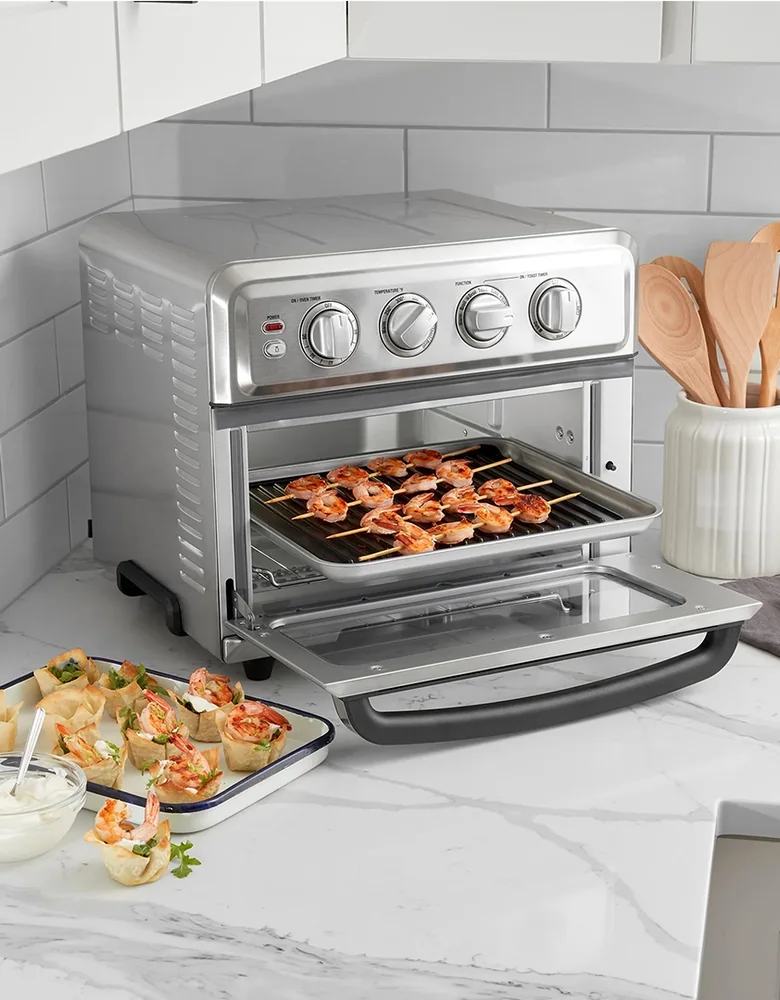
Choose a convection oven for flat foods, large portions, baking dishes, and meals that need several components. It is better suited to cookies, sheet-pan dinners, casseroles, larger pizzas, and multiple trays when the oven supports them. A countertop oven with an air-fry setting sits between the two: it offers more formats than a basket air fryer, but it takes more counter space and usually has more racks, trays, and door seams to clean.
What this guide helps you understand
Choose an air fryer for compact, crisp-focused batches and a convection oven for larger pans, larger meals, and more flexible cooking formats.
Measure usable counter space, cabinet clearance, and the room needed to open a basket or oven door.
Compare the flat cooking area, not only quart capacity or oven volume.
Plan to spread food out rather than filling any basket or pan to its rim.
Technique notes
Oven-style air fryers and convection ovens often require more cleanup because racks, trays, crumb areas, and door seams collect grease and crumbs.
Safety note: Keep heat and steam clearance around countertop appliances, especially beneath cabinets, and follow the appliance maker's placement guidance.